
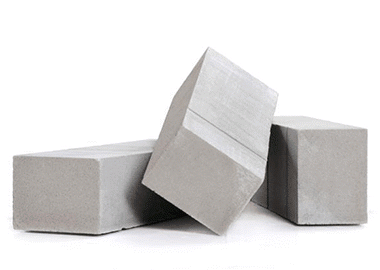
AAC Blocks also known as autoclaved cellular concrete (ACC) or autoclaved lightweight concrete( ALC). It is a lightweight, precast building material that simultaneously provides structure, insulation, and fire and mold resistance.AAC products include AAC blocks, AAC U Blocks AAC wall panels, AAC floor and roof panels, and AAC lintels.
| Pricing | 2500 per CBM |
| Stock Availability | AVAILABLE |
AAC BLOCKS at Affordable Prices in Ghaziabad, Noida, Gurgaon & Sonipat Haryana
AAC Blocks Manufacturers in Delhi NCR
Autoclaved Aerated Concrete (AAC) is a lightweight, load-bearing, high-insulation building material produced in a range of sizes and strengths. Compared to red clay bricks, AAC blocks are roughly three times lighter, which changes both how a building is constructed and how it performs over its lifetime — from faster wall-raising to a measurably cooler interior. Garg Build Solutions manufactures AAC blocks from its Sonipat, Haryana facility, supplying Ghaziabad, Noida, Gurgaon, and the wider Delhi NCR construction market.
What Are AAC Blocks, Exactly?
AAC — also known as autoclaved cellular concrete (ACC) or autoclaved lightweight concrete (ALC) — is produced from a mix of fly ash or quartz sand, lime, cement, gypsum, water, and a small quantity of aluminium powder. The aluminium reacts with the alkaline mix to generate hydrogen gas, which creates millions of tiny air pockets throughout the material before it's cured. AAC typically contains 60% to 85% air by volume, which is the entire reason it's so much lighter than conventional concrete or clay brick while still holding real structural strength. Once cast and cut to size, the blocks are hardened through steam-curing in a pressurised autoclave — a step that distinguishes true AAC from ordinary lightweight aerated concrete that's merely air-cured.
Why AAC Outperforms Red Brick on the Numbers That Matter
The case for AAC isn't a marketing claim — it shows up directly in the physical properties. Thermal conductivity for AAC runs around 0.16-0.18 W/mK, against roughly 0.81 W/mK for clay brick, which is why AAC-walled interiors run measurably cooler without extra insulation layers. At standard wall thickness, AAC also carries a fire resistance rating of up to 4 hours, a sound transmission class in the 40-45 dB range for basic acoustic separation, and a dry density of just 550-650 kg per cubic metre — around a third of a comparable brick wall's weight. On a multi-storey building, that lighter dead load is a genuine structural input, not just a convenience, since it reduces what the columns, beams, and foundation need to carry.
Technical Specifications
| Property | Typical Value |
|---|---|
| Dry Density | 550 - 650 kg/m³ |
| Compressive Strength (Grade 1) | 3 - 5 N/mm² |
| Thermal Conductivity | 0.16 - 0.18 W/mK |
| Fire Resistance | Up to 4 hours (standard wall thickness) |
| Sound Transmission Class | 40 - 45 dB |
| Standard Block Size | 600 x 200 x (100 / 150 / 200) mm |
| Governing Standard | IS 2185 (Part 3) |
Current Delhi NCR Market Price
| Product | Size | Price per Piece |
|---|---|---|
| Standard AAC Block | 600 x 200 x 200 mm | Approx. ?47 - 58 |
| AAC Block | 600 x 200 x 150 mm (6") | Approx. ?37 - 47 |
| AAC Block | 600 x 200 x 100 mm (4") | Approx. ?26 - 32 |
Prices reflect Delhi NCR market rates and vary by brand, order volume, and delivery location. Contact us directly for current Garg Build Solutions pricing.
AAC Block Manufacturing Process
The quality of an AAC block comes down to how tightly each stage of production is controlled. Raw materials — fly ash, lime, cement, gypsum, and aluminium powder — are mixed into a slurry and poured into large moulds, where the aluminium reaction causes the mix to rise, roughly doubling in volume over a few hours. Once it reaches the right consistency, the still-soft block is cut into precise sizes using wire cutters, which is what gives AAC its characteristically sharp, uniform edges compared to a moulded clay brick. The cut blocks then go into an autoclave, where high-pressure steam at around 180-190°C cures the material for several hours, converting the mix into a stable calcium silicate hydrate structure. This autoclaving step is non-negotiable for genuine AAC — skipping it or air-curing instead produces a weaker, less dimensionally stable block that shouldn't be confused with properly autoclaved product.
Where Lime Fits Into AAC Block Manufacturing
Lime is one of the core binding ingredients in AAC, alongside cement — it's part of what reacts with the fly ash or sand to form the block's structural matrix during autoclaving. Consistent lime purity affects the same things in AAC that it affects in fly ash brick manufacturing: reaction completeness, final strength, and dimensional stability. Garg Build Solutions supplies its own hydrated lime for this exact reason — sourcing the binder in-house rather than depending on a third party removes one major variable from the production process.
If you're looking specifically for a gypsum-based plaster to finish AAC block walls, that's a separate product from the AAC block itself, and worth sourcing from a dedicated plaster supplier rather than treating it as part of the block specification — mixing the two on a single page tends to confuse buyers searching for one or the other.
Advantages of AAC Blocks
- Eco-friendly & Sustainable — uses fly ash, a thermal power plant by-product, reducing both waste and the need for clay mining
- Lightweight — roughly a third of the weight of an equivalent clay brick wall
- Thermally Insulated & Energy Efficient — lower cooling load than conventional brick walls
- Fire Resistant — non-combustible, with ratings up to 4 hours at standard thickness
- Acoustic Performance — cellular structure provides reasonable sound insulation for interior and partition walls
- Easy Workability & Design Flexibility — can be cut, drilled, and shaped on site more easily than dense concrete block
- Low Maintenance — dimensional stability reduces cracking and long-term plaster maintenance
Where AAC Blocks Are Used
AAC's combination of strength, light weight, and insulation makes it suitable across a wide range of building types — residential homes, commercial and industrial buildings, schools, hospitals, hotels, and multi-storey RCC-frame structures where reducing dead load matters for the structural design. Industrial buyers also use AAC-compatible quick lime and related binders in adhesives manufacturing, a smaller but steady demand channel alongside core construction use.
The Current AAC Market in India
India's AAC blocks and panels market was estimated at roughly ?4,592 crore in FY2025, with industry projections putting it at around ?10,931 crore by FY2032 — a cited growth rate of approximately 11.51% CAGR. AAC currently represents an estimated 7-8% of the conventional brick market nationally, a minority but steadily growing share as more contractors and developers get comfortable with thin-joint AAC construction. Over 100 AAC manufacturing plants now operate across India, with combined estimated capacity exceeding 15 million cubic metres annually — reflecting just how quickly capacity has scaled over the past few years.
Sourcing AAC Blocks in Ghaziabad, Noida, Gurgaon & Sonipat
For buyers across the Delhi NCR belt, proximity to the manufacturing plant still matters even though AAC is lightweight per piece — it's still heavy to move in bulk by the cubic metre, and logistics cost can run close to a fifth of delivered cost. Garg Build Solutions, manufacturing from Sonipat, supplies AAC blocks directly into Ghaziabad, Noida, and Gurgaon, alongside its fly ash bricks and concrete blocks range — worth a direct conversation on current pricing and delivery timelines before finalising your order quantity.
Frequently Asked Questions
What are AAC blocks made of?
AAC blocks are made from a mix of fly ash or quartz sand, lime, cement, gypsum, water, and a small amount of aluminium powder, which reacts to create the gas bubbles responsible for the block's cellular, lightweight structure. The mix is cast, cut to size, and then steam-cured under pressure in an autoclave.
How much lighter are AAC blocks than red bricks?
AAC blocks are roughly three times lighter than red clay bricks, with a dry density of around 550-650 kg per cubic metre compared to 1,800-2,000 kg per cubic metre for clay brick.
Are AAC blocks fire resistant?
Yes, AAC blocks are non-combustible and typically carry up to a 4-hour fire resistance rating at standard wall thickness, making them suitable for fire-rated wall applications.
What size AAC blocks are available?
AAC blocks are commonly supplied in 600 mm length by 200 mm height, with thicknesses ranging from around 100 mm to 200 mm depending on whether the wall is a partition, load-bearing, or external wall.
Can AAC blocks be used for load-bearing walls?
Yes, AAC blocks can be used for load-bearing masonry in low-rise construction up to G+3 as per IS 1905, though for taller structures they are more commonly used as non-load-bearing infill within an RCC frame.
Do AAC blocks need special mortar?
AAC blocks perform best with a thin-bed adhesive mortar applied in a 2-3 mm layer rather than conventional thick cement-sand mortar, which reduces both mortar consumption and joint-related heat loss.
| Size | Length : 625 mm, Height : 200 to 250 mm |
| Weight | 2900 gms |
| Density | Dry Density : 550-650 kg/m3 |
| Strength | Normal Compressive Strength : 40 kg/cm2 |
| Absorption | Sound Absorption : 43 for 150 mm Wall Db |